
Introducing "Food for Thought" #104. The formula is simple: three short messages 2x a month to feed your mind.
Composition
The Topgrading matrix to evaluate your team
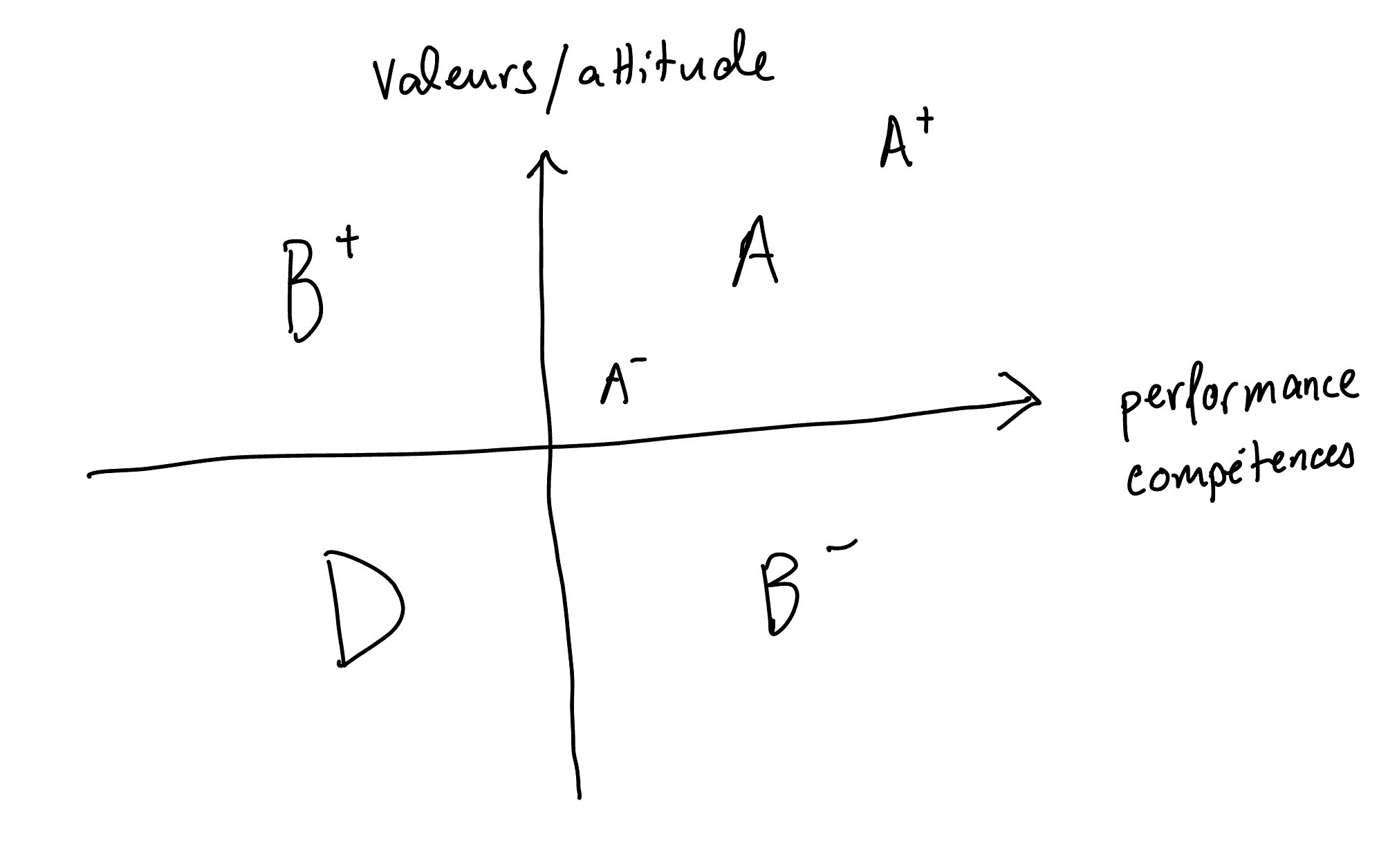
Here's an exercise we use regularly to think about team composition. Inspired by the Topgrading approach developed by organizational psychologist Bradford D. Smart, we've adapted it to our reality.
The exercise involves positioning each team member along two axes:
- Adherence to values / attitude
- Performance / skills
This matrix often puts into words intuitions that we already have as managers, but which we've never really taken the time to analyze.
Management
A few questions to ask yourself
For A (Values + Performance)
- How can I recognize them better?
- What additional challenges can I offer them to keep them coming back?
For B+ (strong values, variable performance)
- What obstacles prevent them from reaching their full potential?
- What can I do to help them become A's?
For B- (strong performance, fragile values)
- If I had to hire them again today, would I?
- Are they coachable?
- What behaviors do they need to change to become A?
- What is the hidden cost of keeping this type of player on the team?
For Ds (low value and low performance)
- What conversations do you currently avoid with these profiles?
- Five years from now, do you still want them on your team?
- What happens in your culture when you tolerate the situation?
Teamwork
The importance of multiplying perspectives
We recently carried out this exercise with a management team. One manager saw an employee as a D, while another saw him as an A.
Who was right? Probably both... and neither. As managers, we're all influenced by our experiences, expectations, preferences and biases. A difficult relationship, a recent event or an outstanding achievement can easily color our perception.
That's why the best decisions are rarely made alone. Before concluding that an employee is an A or a D, take the time to consult other managers, colleagues or partners who work with this person. Often, the truth lies somewhere between the two perceptions.
